At Ananta RCM, we optimize your practice’s financial health with tailored, end-to-end medical billing solutions. From swift claim submissions and specialty coding to aggressive denial management, our team ensures faster reimbursements and higher clean-claim rates. Eliminate administrative burden and focus on exceptional patient care while we manage your entire revenue cycle.
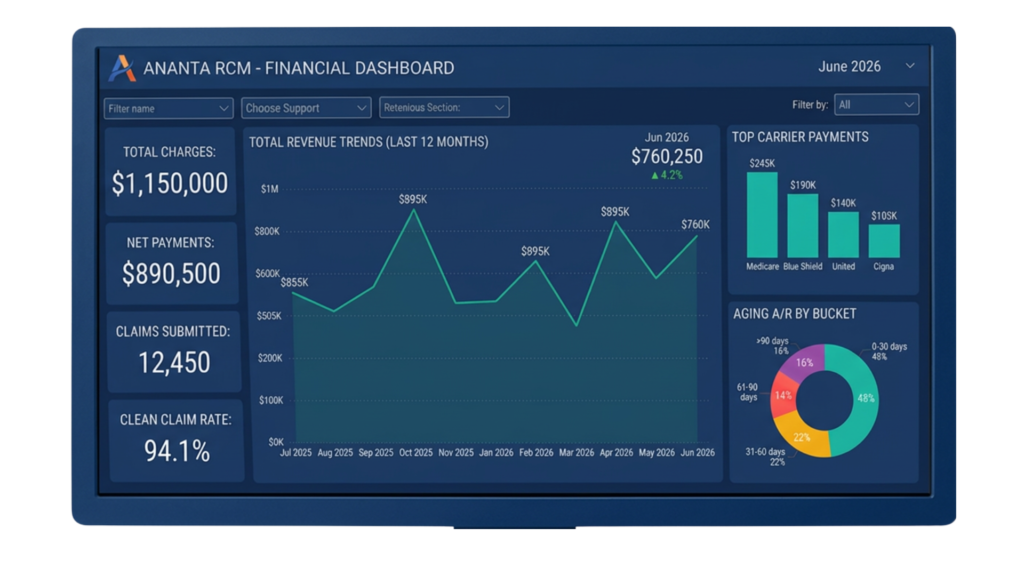
End-to-End Claim Management: Swift, accurate generation and electronic submission of primary, secondary, and tertiary claims.
Pre-Submission Scrubbing: Automated scrubbing against current payer guidelines to eliminate coding errors before submission.
Patient Insurance Verification: Real-time eligibility, copay, and deductible checks prior to patient appointments to prevent coverage surprises.
Timely Payment Posting: Rapid posting of Electronic Remittance Advices (ERAs) and Explanation of Benefits (EOBs) to keep account ledgers accurate.
Patient Statement & Collection Management: Easy-to-understand billing statements with flexible online payment options for higher self-pay recovery.
Aging AR Follow-Up: Persistent, systematic tracking of outstanding accounts over 30+ days to drastically reduce unpaid claims.

“Did You Know? The average US medical practice waits 40+ days to get paid by insurance companies. We reduce your AR cycle to under 30 days while maintaining a 98% First-Pass Claim Rate.”
AAPC & AHIMA Certified Coders: Highly trained specialists proficient in ICD-10-CM, CPT, HCPCS Level II, and specialty-specific coding rules.
Comprehensive Chart Audits: Routine reviews of clinical documentation to identify missed revenue opportunities and prevent over/under-coding compliance risks.
Specialty-Specific Coding Expertise: Tailored coding solutions across primary care, surgical subspecialties, emergency medicine, radiology, and outpatient facilities.
HCC & Risk Adjustment Coding: Precise coding for Medicare Advantage and Value-Based Care models to ensure accurate patient risk scoring and reimbursement.
Denial Prevention & Appeal Coding: Fast identification and corrective coding for rejections caused by modifier mismatches or documentation gaps.
Seamless EHR Integration: Direct coding within your existing EHR/EMR platforms to streamline updates and reduce administrative overhead.

“Did You Know? Up to 80% of medical bills contain coding errors, leading to delayed claims and compliance audits. Our certified coders maintain a 99% accuracy rate, helping you eliminate rejections and protect practice revenue.”
Root-Cause Analysis: Comprehensive evaluation of rejections to identify patterns, recurring coding issues, or eligibility breakdowns before resubmission.
Rapid Claims Appeals: Swift generation and submission of formal appeal packages with supporting clinical documentation for faster reversals.
Payer Trend Tracking: Continuous monitoring of changing commercial and government payer rules to update billing rules and prevent future denials.
Timely Filing Management: Priority handling of rejected claims to ensure re-submissions meet strict payer deadlines and eliminate write-offs.
Underpayment Recovery: Systematic audits of paid claims to detect underpaid contracts, fee-schedule discrepancies, and missed reimbursements.
Custom Reporting & Insights: Clear dashboards tracking denial rates, recovery percentages, and operational actionable recommendations for your team.

“Did You Know? Nearly 65% of denied healthcare claims are never resubmitted, leaving thousands of dollars in uncollected revenue behind. Our specialist team maintains a 92% overturn rate, recovering the revenue your practice already earned.”
Payer Enrollment & Contracting: Complete end-to-end management of applications for commercial insurance, Medicare, Medicaid, and Medicare Advantage networks.
CAQH Profile Management: Routine creation, maintenance, and bi-monthly re-attestations to keep your Council for Affordable Quality Healthcare profiles fully compliant.
Primary Source Verification: Rigorous background checks on medical licenses, DEA registration, board certifications, education, and work history.
Re-Credentialing & Expiration Tracking: Proactive tracking of upcoming license renewals and contract re-credentialing deadlines to prevent coverage gaps.
Facility & Hospital Privileging: Streamlined application handling to secure hospital admitting privileges and outpatient facility accreditations faster.
Delegated Credentialing Support: Dedicated coordination for group practices and multi-provider clinics to accelerate group enrollment timelines.

“Did You Know? The average provider enrollment process takes 90 to 120 days, causing thousands in lost patient revenue while providers wait to see patients. We streamline application workflows to reduce credentialing processing times by up to 60%.”
Pre-Visit Eligibility Verification: Automated and manual verification of active patient coverage, effective dates, and policy benefits prior to appointments.
Co-pay & Deductible Calculation: Clear identification of copays, co-insurance, remaining deductibles, and out-of-pocket maximums for accurate upfront collection.
Prior Authorization Management: Swift submission and follow-up on prior authorizations, referrals, and pre-certifications to prevent care delays.
Primary & Secondary Payer Coordination: Verification of Coordination of Benefits (COB) to ensure claims are billed to the correct primary and secondary payers.
Coverage Change Alerts: Real-time flagging of policy cancellations, out-of-network status, or payer plan changes to eliminate claim rejections.
Seamless Scheduling Integration: Daily updating of patient verification status directly within your Practice Management (PM) or EHR system.

“Did You Know? Over 23% of all healthcare claim denials stem from eligibility and registration errors made before the patient even sees the doctor. Our verification service achieves a 95% reduction in front-end eligibility denials, ensuring smooth cash flow.”
Prior Authorization Processing: End-to-end handling of pre-authorizations for medical procedures, diagnostic imaging, specialty drugs, and surgeries.
Payer Portal Navigation: Direct management across major health plan portals, ensuring faster submissions and real-time approval status tracking.
Clinical Documentation Gathering: Collecting and organizing medical records, physician notes, and treatment plans to meet strict medical necessity criteria.
Retroactive Authorization Support: Rapid turnaround for urgent care or retro-authorizations to prevent coverage write-offs after treatment.
Peer-to-Peer Coordination: Scheduling and supporting peer-to-peer clinical reviews between physicians and medical directors when initial requests are flagged.
Proactive Status Tracking: Daily monitoring and follow-up on pending authorizations to eliminate treatment delays and last-minute cancellations.

“Did You Know? Up to 24% of all claim write-offs occur because procedures were performed without proper prior authorization. Our dedicated specialists secure approvals upfront, achieving a 98% first-pass authorization rate to safeguard your revenue.”
Unpaid claims and hidden coding gaps are quietly draining your practice’s bottom line every single day. In a quick 30-minute session, we’ll review your recent billing data, pinpoint exactly where revenue is leaking, and give you a clear action plan to recover what you’re owed—completely free and with zero obligation.
Protect practice revenue from costly audit penalties through rigorous, specialty-specific coding verification protocols.
Improve out-of-pocket recovery using modern digital payment portals and clear patient financial communication.
Maintain strict compliance levels while avoiding audit risks with certified specialty-specific medical coders.
Lower operational overhead expenses by streamlining backend administrative processes and software integrations.
Recover lost revenue through systematic workflows designed to challenge and overturn unjust payer denials.
Increase your overall clinical capacity and appointment availability by streamlining front-desk patient intake routines.
Patient insurance verification confirms coverage, active benefits, copays, deductibles, and authorization requirements before medical care is delivered. Verifying these details upfront reduces claim denials, accelerates reimbursements, and sets clear out-of-pocket expectations for patients. Streamlining payer communications early eliminates administrative burdens and maintains a steady practice cash flow. Ananta RCM handles payer interactions directly to enhance patient satisfaction and financial predictability.
Active coverage check
Benefit verification
Authorization tracking
Denial reduction
Upfront cost clarity
Steady cash flow
Patient demographic entry captures and updates core patient, insurance, guarantor, and provider details within your practice management system. Precise data entry prevents duplicate records, registration errors, and payment delays across the billing cycle. Thorough demographic management ensures claims move cleanly through billing workflows without holds. Ananta RCM handles data entry with precision to lower administrative errors and streamline practice billing.
Complete data capture
System profile updates
Duplicate record prevention
Reduced registration errors
Faster claim processing
Workflow accuracy
Accurate medical coding translates clinical documentation into standardized CPT, ICD-10, and HCPCS codes that reflect patient care. Proper coding ensures compliance with CMS guidelines, reduces audit risks, and prevents revenue loss from denied claims. Coding specialists review clinical charts to capture all billable services across specialties. Ananta RCM ensures precise coding to protect practice compliance and maximize reimbursement.
Standardized code translation
Chart documentation review
CMS guideline compliance
Lower audit risk
Maximized billable services
Revenue loss prevention
Charge entry records coded services, procedures, and fee schedules into your billing system for insurance submission. Accurately capturing charges prevents missing fees, duplicate entries, and payment delays that disrupt cash flow. Pre-submission checks verify documentation and patient details before posting charges. Ananta RCM reviews each charge carefully to maintain clean claims and payer compliance.
Service fee logging
Accurate charge posting
Duplicate entry prevention
Pre-submission detail audits
Missing fee capture
Compliance check adherence
Claim submission transmits validated, coded medical claims to insurance payers following charge entry. Timely, error-free transmission prevents rejections, minimizes administrative rework, and establishes predictable reimbursement cycles. Rigorous pre-transmission reviews check claims against payer-specific rules and demographic accuracy. Ananta RCM routes claims through secure clearinghouses to ensure rapid turnaround times.
Electronic claim transmission
Payer rule scrubbing
Reduced rejection rates
Faster payment cycles
Minimal administrative rework
Secure clearinghouse delivery
Payment posting records insurance payments, patient balances, ERAs, EOBs, contractual adjustments, and write-offs into the billing system. Accurate posting provides clear financial visibility, identifies underpayments, and keeps patient balances up to date. Reconciling every payment allows practices to monitor collections and spot outstanding balances quickly. Ananta RCM reconciles payments precisely to improve financial reporting and ledger accuracy.
ERA/EOB posting
Payment ledger updates
Underpayment identification
Contractual adjustment tracking
Patient balance updates
Accurate financial reporting
Accounts Receivable (AR) management tracks and recovers outstanding insurance and patient balances to maximize collections and improve cash flow. AR specialists proactively follow up on unpaid or delayed claims by contacting payers and reviewing aging reports. Implementing strategic follow-ups reduces aging accounts, minimizes write-offs, and strengthens practice financial health. Ananta RCM manages AR recovery directly so providers can focus on care.
Outstanding balance tracking
Proactive payer follow-up
Aging report monitoring
Write-off reduction
Increased collection rates
Improved cash flow
Denial management identifies, investigates, appeals, and corrects denied or underpaid claims to recover lost revenue. Specialists perform root-cause analysis on rejections, gather documentation, and submit detailed appeals to payers. Tracking denial trends helps eliminate recurring billing errors and improves future claim accuracy. Ananta RCM actively resolves denials to maximize practice reimbursement and operational efficiency.
Root-cause error analysis
Denied claim investigation
Comprehensive appeal filing
Denial trend tracking
Lost revenue recovery
Recurring error prevention
Reporting and analytics offers healthcare providers actionable insights into financial performance, billing efficiency, and claim trends. Customized reports track key revenue cycle metrics, collection rates, and operational bottlenecks. Having clear data helps practice leaders make informed decisions to optimize overall performance. Ananta RCM provides detailed financial analytics to support strategic decision-making.
Key performance metrics
Custom report generation
Collection rate tracking
Revenue cycle insights
Operational efficiency analysis
Data-driven decision support